
Six Pillars of Digital Marketing for Consistent Leads
Consistent leads rarely come from one tactic. Six connected marketing pillars — awareness, organic outreach, engagement, paid advertising, referrals, and events and partnerships — sit on a foundation of clear goals, a defined audience, and a strong customer experience.
Written by Leonardo “Leo” Sanchez
Small-business owners are often told that one marketing tactic will solve their growth problems. Post more on social media. Run paid advertisements. Improve SEO. Send more emails. Ask for referrals.
Each of those activities can help, but none of them works entirely on its own.
A business may run effective advertisements but lose potential customers because the brand is unfamiliar. It may publish helpful content but fail to respond when people engage. It may provide excellent service but never ask satisfied customers for reviews or referrals.
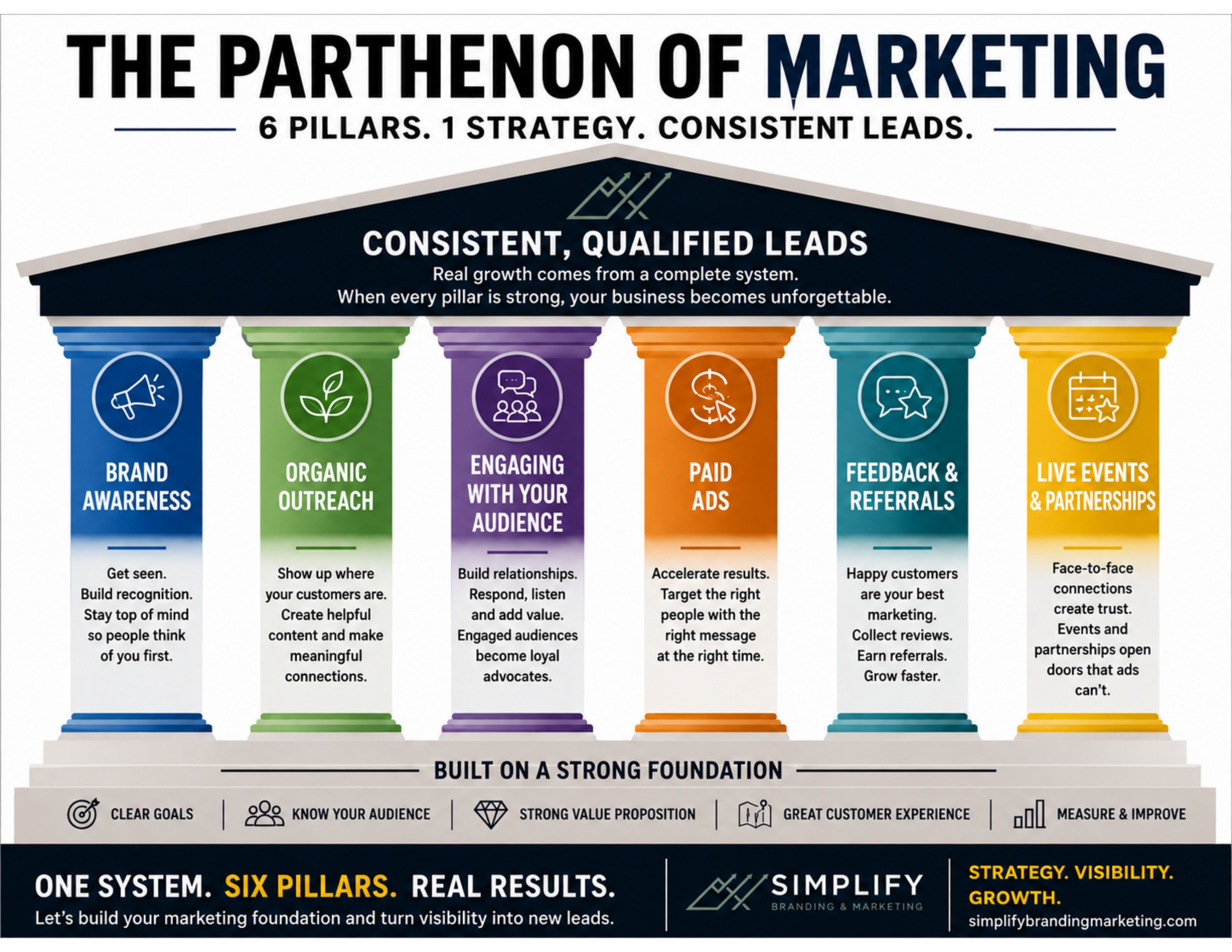
This is why I developed what I call the Parthenon of Marketing — a framework built on six pillars of digital marketing that work together. Like a physical structure, a strong marketing system depends on several connected pillars. Each pillar has a different purpose, but they all support the same outcome: more consistent, qualified leads.
What Are the Six Pillars of Digital Marketing?
It is a small-business marketing framework built around six connected areas:
- Brand awareness
- Organic outreach
- Engaging with your audience
- Paid advertising
- Feedback and referrals
- Live events and partnerships
Underneath those pillars is the foundation: clear goals, a defined audience, a strong value proposition, a positive customer experience and a process for measuring results.
The central idea is simple. Customers rarely choose a business after seeing it only once. Someone may notice a social media post, hear about the business from a friend, visit the website, read reviews and then make contact. Each interaction helps build familiarity and trust. Marketing works best when those interactions feel connected.
Pillar 1: Brand awareness
Brand awareness helps people recognize your business and understand what it provides. It includes your visual identity, messaging, reputation and the consistency of your presence.
A potential customer should be able to understand what you do, who you help and why your business is worth remembering.
For most small businesses, the goal is not to become nationally famous. The goal is to become familiar and credible within the specific market or community you serve.
Strong brand awareness makes every other marketing activity more effective, because customers are more likely to respond to a business they recognize and understand. But visibility alone is not enough — if your site is getting visitors without inquiries, read why your website gets traffic but no leads.
Pillar 2: Organic outreach
Organic outreach helps your business appear where potential customers are already searching, learning and communicating. This can include:
- Website articles
- Search engine visibility
- Social media content
- Local business listings
- Community-group participation
- Email communication
- Direct outreach
- Helpful guides and resources
The purpose should not be to promote your services constantly. Strong organic outreach answers questions, provides useful guidance and demonstrates that you understand the customer’s challenges. It helps your business become useful before asking for the sale.
Pillar 3: Engaging with your audience
Publishing content is not the same as building relationships. Engagement happens when a business listens, responds and participates in conversations. This may include replying to messages, answering comments, responding to reviews, following up with inquiries and asking customers about their needs.
These conversations also provide valuable information. The questions people ask, the concerns they raise and the reasons they hesitate can help improve your services, messaging and overall customer experience.
Instead of assuming what customers want, engagement allows you to hear directly from them. If attention is not turning into leads, this is often where the breakdown shows up — something I wrote about in making sure you are solving the right problem. And when engagement does turn into an inquiry, slow follow-up is usually where those leads slip away — see why small businesses lose leads through inconsistent follow-up.
Pillar 4: Paid advertising
Paid advertising can increase visibility and generate inquiries, but it cannot repair a weak marketing foundation. Advertising works best when the business already has:
- A defined audience
- A clear offer
- Credible branding
- A useful website or landing page
- A clear next step
- A reliable follow-up process
- A way to measure results
When advertising underperforms, the advertisement itself may not be the only problem. Weak targeting, unclear messaging, low trust, poor lead quality or slow follow-up can all reduce results.
Paid advertising should strengthen a working customer journey rather than replace one. Before increasing a budget, it is worth reading before you spend more on marketing.
Pillar 5: Feedback and referrals
Satisfied customers can become one of a business’s strongest marketing resources. Their feedback helps improve the customer experience, while reviews, testimonials and referrals help future customers feel more confident.
This pillar may include:
- Asking for reviews
- Requesting referrals
- Following up after a service
- Collecting testimonials
- Conducting customer surveys
- Learning from complaints
- Tracking repeated concerns
Feedback should not only be used to collect praise. Honest criticism can reveal breakdowns in communication, expectations, service delivery or follow-up. Referrals are especially valuable because trust is transferred from an existing relationship to a new potential customer. Reviews play a similar role, which I covered in how to get more Google reviews for your small business.
Pillar 6: Live events and partnerships
Digital marketing matters, but in-person visibility and professional relationships are still important, particularly for local businesses. Live events and partnerships may include:
- Community events
- Networking meetings
- Local sponsorships
- Workshops
- Trade shows
- Chamber of commerce events
- Nonprofit partnerships
- Collaborations with complementary businesses
For example, a contractor may build relationships with real-estate professionals. A wellness business may partner with a local gym. A photographer may collaborate with an event planner.
These relationships can create direct introductions, referrals, content opportunities and stronger local credibility.
The foundation beneath the pillars
The six pillars cannot support consistent growth without a strong foundation. That foundation includes:
Clear goals
“Get more customers” is too broad. A clearer goal might be generating five qualified estimates each month, increasing repeat bookings or attracting more commercial clients.
A defined audience
Marketing becomes more effective when a business understands who it wants to reach, what those customers need and how they make decisions.
A strong value proposition
Your value proposition should explain the problem you solve, the people you serve and why someone should choose your business.
A strong customer experience
Marketing does not end when a lead arrives. Response time, communication, service quality and follow-up all influence whether interest becomes a sale or referral.
Measurement and improvement
Businesses should look beyond followers and website views. More meaningful measurements may include qualified inquiries, appointments, estimates, conversion rates, referral sources, repeat business and revenue generated.
Which pillar is limiting your results?
A business does not need to invest equally in all six pillars at the same time. The first step is to evaluate what is already working and where the customer journey may be breaking down.
Ask yourself:
- Do potential customers quickly understand what our business provides?
- Are we visible where our ideal customers spend time?
- Do we respond and engage consistently?
- Are our advertisements supported by a strong website and follow-up process?
- Are we collecting feedback, reviews and referrals?
- Are we developing relationships in our local or professional community?
- Are we tracking qualified leads and conversions?
If you would like a structured way to answer those questions, the free Marketing Clarity Assessment walks through audience, messaging, visibility, website and follow-up, and the Marketing Gap Action Guide turns what you find into next steps.
The goal is not to add more disconnected marketing activity. The goal is to create a connected system in which each pillar supports the others — the same idea behind a well-built marketing funnel for small business.
One system. Six pillars. Real results.
Consistent lead generation rarely comes from one advertisement, one platform or one campaign. It comes from visibility, familiarity, trust, a strong customer experience and consistent follow-through.
This framework gives small-business owners a practical way to understand how those efforts connect. Instead of asking, “Which marketing tactic should I try next?” ask: “Which part of my marketing structure is limiting the results of everything else?”
That question can lead to better decisions, better use of your budget and a stronger path toward sustainable growth. If you want help working through it, take a look at how I work with small businesses or send me a message.
Want help finding your weakest pillar?
If you would rather have an outside perspective, there are two ways to start:
- Free first step: Take the Marketing Clarity Assessment — a free self-assessment across audience, messaging, visibility, website, and follow-up.
- Paid next step: The Small Business Marketing & Lead Generation Audit — a one-time $249 review of where your marketing is losing leads, with a written plan for your highest-priority fixes.
Download the one-page guide
The Parthenon of Marketing one-page guide provides a visual summary of the six pillars and the foundation that supports them.
Download the Parthenon of Marketing Guide
Created by Leonardo “Leo” Sanchez, founder of Simplify Branding and Marketing and a New Jersey-based marketing strategist. You can also see the full Parthenon of Marketing resource page or browse all free marketing resources.
Frequently Asked Questions
What are the six pillars of the Parthenon of Marketing?
The six pillars are brand awareness, organic outreach, audience engagement, paid advertising, feedback and referrals, and live events and partnerships.
Why is brand awareness important for lead generation?
Brand awareness helps potential customers recognize, understand and remember a business. Customers are generally more comfortable contacting a company that appears familiar and credible.
Can paid advertising generate leads by itself?
Paid advertising can generate attention and inquiries, but results also depend on targeting, messaging, credibility, the website experience and the business’s follow-up process.
Does every small business need all six marketing pillars?
Businesses may emphasize different pillars depending on their customers, goals and resources. However, ignoring important parts of the customer journey can weaken overall results.
Get one practical small-business marketing tip each week.
No fluff. Just simple ideas to help improve your website, marketing, and lead generation.