Marketing Funnels for Small Business: What Makes a Good One (and Why Most Owners Skip It)
A marketing funnel is not complicated software. It is the connected path people take from first discovering your business to becoming a customer and potentially returning or referring others.
Written by Leonardo “Leo” Sanchez
A business may be posting on social media, running advertisements, collecting reviews and sending emails without seeing a consistent flow of customers.
The problem may not be a lack of marketing activity. The problem may be that those activities are not connected.
A potential customer may see an advertisement but land on a confusing website. Another may read a helpful article but find no clear next step. Someone else may request information but never receive a timely follow-up.
That’s the role of marketing funnels for small business: they connect the path between first visibility and a real customer relationship — and they don’t need to be complicated.
For most small businesses, a useful funnel answers five questions:
- How do people discover the business?
- What helps them understand and trust it?
- How do they express interest?
- What happens after they make contact?
- How does the business encourage repeat business, reviews and referrals?
What Is a Marketing Funnel for a Small Business?
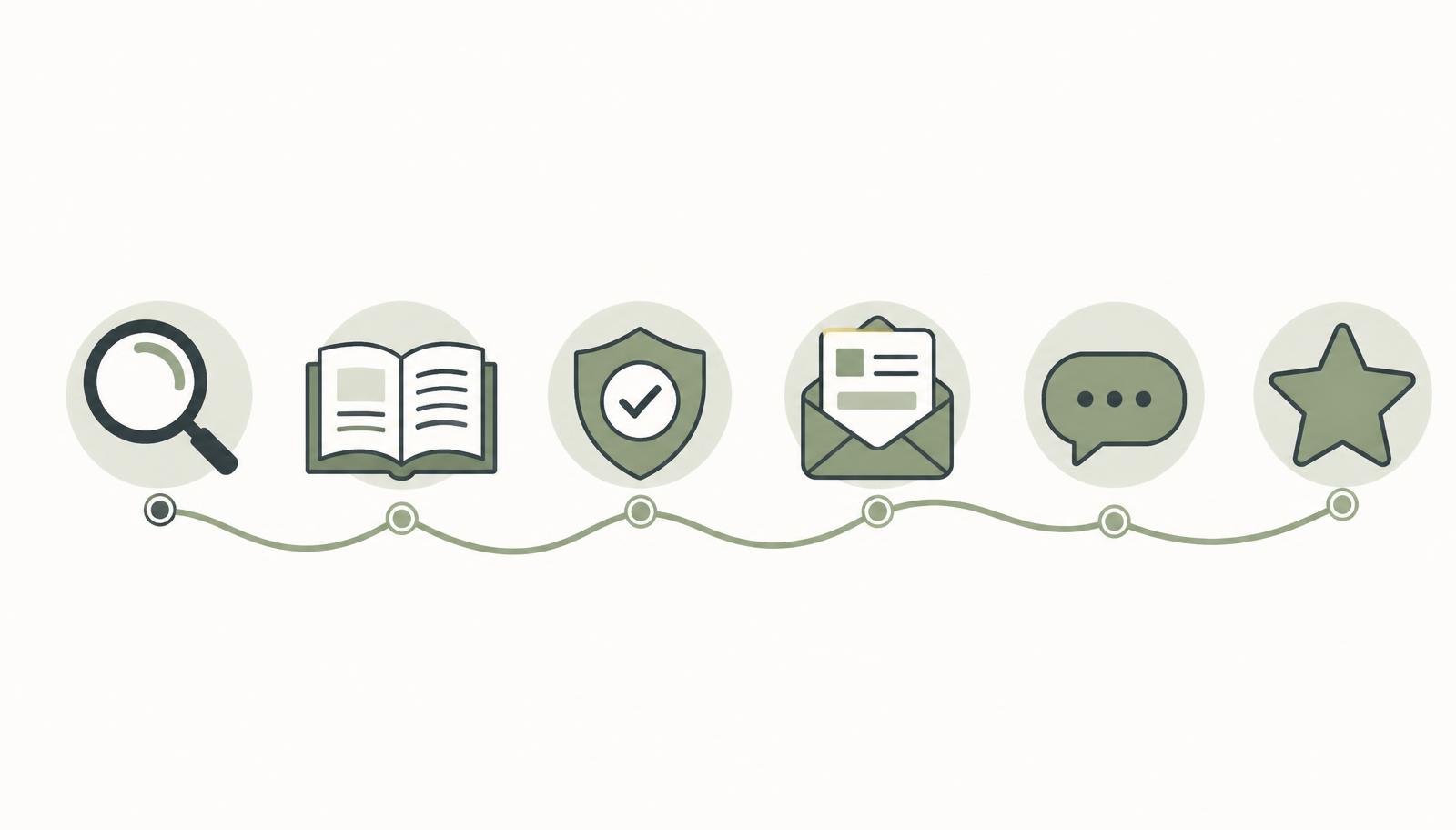
A marketing funnel represents the stages a potential customer may move through before, during and after a purchase. A simple funnel may include:
- Awareness
- Interest
- Consideration
- Action
- Follow-up
- Retention and referral
The journey is not always a straight line. A person may:
- Visit the website several times
- Read reviews before following the business
- See a social post and contact the business weeks later
- Request an estimate, pause and return later
- Become a customer through a referral after seeing previous marketing
The funnel is not intended to force every customer into one rigid path. It helps the business make each important step clearer and easier, and it is one practical way to connect the six pillars of the Parthenon of Marketing.
Stage 1: Awareness
Awareness is how people first discover the business. Possible awareness channels include:
- Google Search
- Google Maps
- Social media
- Paid advertising
- Referrals
- Local events and community groups
- Partnerships
- Signs or printed materials
- Articles and educational content
- Public relations or industry mentions
The goal at this stage is not always an immediate sale. The goal may be to help the right person recognize that the business exists, that it serves their area or audience, that it understands their problem and that it may be worth learning more about.
Awareness becomes wasteful when it reaches the wrong audience or communicates an unclear message, so it helps to first clarify what makes the business relevant to the right customer.
Stage 2: Interest and Education
After discovering a business, customers often need more information. They may visit the homepage, a service page, an About page, a social profile, a Google Business Profile, an article, a frequently asked questions section or a resource guide.
At this stage, the business should help customers understand:
- What the business provides
- Who the service is for
- What problem it solves
- How the process works
- Whether the business serves their location
- What the next step involves
- Whether the business appears credible
Useful content may include educational articles, service explanations, common questions, process information, preparation guidance, videos, checklists and comparisons. The simplest starting point is to answer the questions customers need before making a decision.
Stage 3: Consideration and Trust
At this point a potential customer may be comparing providers or deciding whether to act. Trust signals may include:
- Genuine customer reviews
- Testimonials
- Clear founder or team information
- Relevant experience and credentials
- Process explanations
- Examples of work
- Transparent service descriptions
- Clear pricing or pricing factors
- Contact information and service-area details
- Professional responses to customer feedback
Every business will have different forms of proof, and none of it should be invented. A strong promise without evidence may attract attention, but proof helps customers feel comfortable moving forward. For most local businesses, the practical first step is to build a genuine Google review process.
Stage 4: Conversion
Conversion is the action the business wants the potential customer to take. Examples include a call, an estimate request, a booked appointment, a completed contact form, a purchase, a scheduled consultation, a downloaded resource, an email-list signup or an event registration.
Not every conversion is a sale. A useful conversion step should be clear, relevant, easy to complete, appropriate for the customer’s level of interest and connected to a defined follow-up process.
Too many competing calls to action can create confusion. On important service or landing pages, use one primary next step.
Make the Conversion Process Easy
Review whether:
- The contact form is too long
- The phone number is easy to find
- The website works on mobile
- The page loads properly
- The service area is clear
- The customer understands what happens after submission
- The call to action matches the offer
- Booking options are accurate
- Confirmation messages are sent
A business can spend money generating traffic and still lose customers because the next step is unclear or inconvenient.
Stage 5: Lead Follow-Up
The funnel does not end when someone submits a form or sends a message. A lead should enter a defined follow-up process. That process may include:
- Confirming the inquiry was received
- Responding within a realistic timeframe
- Reviewing the customer’s request
- Asking necessary qualifying questions
- Explaining the next step
- Scheduling a call, appointment or estimate
- Following up when the customer does not respond
- Recording the outcome
Repeated or aggressive follow-up works against the business. A simple sequence may include an immediate confirmation, a personal response, one or two respectful follow-ups and a clear way to reconnect later. Small adjustments here often make customer follow-up feel more relevant and personal, and inconsistent follow-up is one of the most common reasons small businesses lose leads they already earned.
Qualified Leads Versus More Leads
A funnel should help improve lead quality, not only lead volume. A qualified lead may be someone who:
- Is within the service area
- Needs a service the business provides
- Has appropriate timing
- Has a realistic budget
- Is able to make or influence the decision
- Has shown genuine interest
- Fits the business’s capacity and service model
Define what a qualified lead means before evaluating marketing performance. More form submissions do not automatically mean better marketing. The business needs to know whether those inquiries can realistically become customers.
Stage 6: The Customer Experience
Marketing continues after the sale. The customer experience includes onboarding, scheduling, communication, service delivery, expectations, problem resolution, follow-up, billing and support.
A poor customer experience can weaken the entire funnel by reducing repeat business, reviews, referrals, trust and reputation. Marketing creates expectations. The customer experience determines whether the business fulfills them.
Stage 7: Retention, Reviews and Referrals
Existing customers are already familiar with the business and are often easier to reconnect with than completely new audiences. A retention and referral process may include:
- Service reminders
- Follow-up emails
- Maintenance information
- Related-service recommendations
- Customer education
- Review requests
- Referral requests
- Loyalty communication
- Seasonal reminders
- Thank-you messages
Communication should be useful, permission-based and appropriate. A steady Google review process and the visibility pillars in the Parthenon of Marketing both depend on this stage being handled well.
A Simple Small-Business Marketing Funnel Example
Consider a landscaping company.
Awareness
A homeowner finds a seasonal-cleanup article through Google or sees a local social media post.
Interest
The homeowner visits a service page explaining seasonal cleanup, service areas and what the work includes.
Consideration
They review customer feedback, project photos, process information and frequently asked questions.
Conversion
They complete a short estimate-request form.
Follow-up
The business confirms the inquiry, asks for the property address and schedules a walkthrough.
Customer experience
The business provides clear scheduling updates and completes the work as described.
Retention and referral
The customer receives seasonal maintenance information and a respectful request for honest feedback.
This is only one example. Different businesses may use appointments, purchases, consultations or other conversion steps.
Why Small-Business Marketing Funnels Break
- The business targets everyone
- The message is unclear
- The advertisement does not match the landing page
- The website lacks trust signals
- Service details are incomplete
- The call to action is difficult to find
- The contact form asks for unnecessary information
- The business responds too slowly
- Leads are not qualified
- No one records where leads came from
- Follow-up is inconsistent
- The customer experience does not match the marketing promise
- Reviews and referrals are not requested
- The business focuses only on awareness and ignores later stages
Before adding another channel, it is worth working through the journey to identify where the real marketing problem is occurring. For example, a site that attracts visitors but converts few of them is usually showing traffic with no leads — a funnel gap, not a traffic gap.
How to Audit Your Current Funnel
Step 1: Choose one service
Do not audit the entire business at once.
Step 2: Identify the main discovery channels
Where do potential customers first find the service?
Step 3: Follow the customer path
Visit the page, profile or listing the customer sees.
Step 4: Review the trust information
Can the customer understand the business and feel comfortable moving forward?
Step 5: Test the call to action
Complete the form, click the phone number or test the booking process.
Step 6: Review the follow-up
What happens after someone responds?
Step 7: Review lead quality
Are the inquiries appropriate for the business?
Step 8: Review the customer experience
Does the actual service match the marketing promise?
Step 9: Review retention
Is there a process for reviews, repeat business or referrals?
Step 10: Fix the biggest gap first
Avoid rebuilding every marketing channel at the same time.
What Should a Small Business Measure?
Useful funnel measures may include website visits, traffic sources, service-page visits, calls, form submissions, appointment requests, qualified leads, cost per qualified lead, response time, lead-to-appointment rate, lead-to-customer rate, reasons leads are lost, sales, repeat business, reviews and referrals.
A small business does not need an overly complex dashboard. Start by answering:
- Where do leads come from?
- Which leads are qualified?
- How quickly are they contacted?
- How many become customers?
- Why are opportunities lost?
Do You Need Funnel Software?
Many businesses can begin with simple tools such as website forms, email, a calendar, a spreadsheet, a customer relationship management system, appointment software, basic analytics and written follow-up templates.
Software can help organize the process, but it cannot fix an unclear offer, weak messaging, poor lead quality, slow responses, a confusing website or an inconsistent customer experience. Build the process first. Then choose technology that supports it, and avoid using technology as a substitute for a clear process.
Final Thoughts
A small-business marketing funnel does not need to be complicated. It needs to connect the important steps between visibility and a real customer relationship.
Help the right people discover the business. Give them useful information. Build trust. Make the next step clear. Respond consistently. Deliver the experience promised. Stay connected afterward.
When leads are not converting, do not automatically assume the business needs more traffic. Review the entire customer journey and identify where people are getting confused, losing confidence or receiving no follow-up. Fixing one broken stage may create more value than adding another disconnected marketing tactic. If you’d like an outside set of eyes on the whole journey, Simplify’s marketing strategy and lead-generation support is built around exactly that.
Review Your Own Funnel
Not sure where potential customers are being lost? There are two ways to find out.
Start free: Use the Marketing Clarity Assessment to review your audience, messaging, visibility, website, conversion process and follow-up on your own.
Take the Free Marketing Clarity Assessment
Want an outside set of eyes? The Small Business Marketing & Lead Generation Audit ($249) is a one-time review of your website, messaging, lead flow, local visibility and basic SEO, calls-to-action, and current marketing channels — with prioritized recommendations and a written 30-day action plan.
Request the $249 Marketing & Lead Generation Audit · Explore Services · Read Before You Spend More on Marketing · Explore the Parthenon of Marketing
Frequently Asked Questions
What is a marketing funnel for a small business?
A marketing funnel is the connected journey a potential customer takes from discovering a business to learning more, making contact, becoming a customer and potentially returning or referring others.
Does a small business need funnel software?
Not necessarily. A business can begin with a clear website, contact process, email, calendar, spreadsheet and consistent follow-up. Software can be added when it supports a defined process.
Why are my marketing leads not converting?
Possible causes include poor targeting, unclear messaging, weak trust signals, a confusing website, slow follow-up, inappropriate leads or an offer that does not match customer needs.
What are the main stages of a marketing funnel?
A simple funnel may include awareness, interest, consideration, conversion, follow-up, customer experience, retention and referrals.
How can a small business improve its funnel?
Choose one service, follow the customer journey from discovery through follow-up, identify the largest point of confusion or loss and fix that stage first.
Written by Leonardo “Leo” Sanchez
Leonardo “Leo” Sanchez is a New Jersey-based marketing strategy and customer experience professional and the founder of Simplify Branding & Marketing. He has more than 10 years of experience across marketing strategy, digital content, omnichannel engagement, commercial operations and business problem-solving. He is currently completing his MBA at Penn State. LinkedIn · Full profile
Get one practical small-business marketing tip each week.
No fluff. Just simple ideas to help improve your website, marketing, and lead generation.