
What Makes Your Small Business Different — and How to Communicate It Clearly
Standing out does not require inventing a dramatic claim. It requires understanding which parts of your business matter most to your best-fit customers and communicating those differences clearly.
Written by Leonardo “Leo” Sanchez
Many small businesses provide good service but struggle to explain why a customer should choose them instead of another option. Their website may say:
- High-quality service
- Competitive prices
- Professional team
- Excellent customer service
- Customer satisfaction is our priority
Those statements may be true, but they are also used by thousands of other businesses.
Standing out does not require inventing a dramatic claim or pretending that no competitor can do what you do. It requires understanding which parts of your business matter most to the customers you want to serve and communicating those differences clearly. That is the purpose of a strong value proposition.
What Is a Small-Business Value Proposition?
A value proposition is a clear statement of:
- Who the business helps
- What problem it solves
- What outcome or benefit it provides
- Why the customer should consider this business
- What makes the experience meaningfully different
It is not simply a slogan. A slogan may be memorable, but a value proposition helps the customer understand why the business is relevant.
Before rewriting anything, it also helps to identify the real customer problem before changing your marketing.
Start With the Customer, Not the Business
Many businesses begin by listing their experience, tools, products or services. Those details matter, but customers usually begin with their own situation. They may be thinking:
- Can this business solve my problem?
- Do they understand what I need?
- Can I trust them?
- Will the process be difficult?
- Is this worth the cost?
- What will be different after I hire them?
- Why should I choose them instead of another provider?
A useful value proposition connects your strengths to those concerns.
Service-focused: "We provide residential cleaning services."
Customer-focused: "We help busy homeowners maintain a cleaner home without losing their limited free time."
Service-focused: "We offer lawn-maintenance services."
Customer-focused: "We help local homeowners keep their properties maintained without spending every weekend doing yard work."
The customer-focused versions still need proof and specific service details elsewhere on the page.
Five Places to Look for Meaningful Differentiation
1. Your customer focus
Ask yourself:
- Do you serve a specific type of customer?
- Do you understand a particular need especially well?
- Is your service designed around a specific situation, industry or location?
Examples include residential rather than commercial customers, older homeowners who need dependable ongoing support, local businesses without an internal marketing team, customers with allergies or specific product concerns, or companies preparing for a launch or transition. Serving everyone can make the message less relevant to anyone.
2. Your process
- Is your process easier to understand?
- Do you communicate more consistently?
- Do customers receive clearer expectations?
- Is the work organized in a way that reduces stress?
- Do you provide guidance before and after the service?
A process can be a meaningful difference when it improves the customer experience. Simply giving the process a branded name does not automatically create value.
3. Your experience and expertise
- What relevant experience do you bring?
- What situations have you learned to handle?
- What training, credentials or background matter to the customer?
- What can you explain or solve more clearly because of that experience?
Experience should always be connected to a customer benefit.
Weak: "We have 15 years of experience."
Stronger: "Our experience helps us identify common project issues early and explain the next steps clearly before work begins."
4. Your customer experience
- How quickly do you respond?
- How do you communicate?
- Is scheduling easier?
- Are expectations clear?
- Do customers know what happens next?
- How do you handle concerns?
- Do you provide useful follow-up?
Small differences in communication and reliability can matter more than a flashy brand promise. This is also where marketing that feels personal becomes a genuine advantage.
5. Your values and priorities
Values may include reliability, accessibility, education, sustainability, community involvement, transparency, respect for the customer's budget, long-term relationships or simplicity.
Values become differentiators only when customers can see them in actual behavior. Saying "we care about customers" is not enough — show how that value affects your service, policies or communication.
Ask Customers Why They Chose You
Business owners often do not recognize their strongest differentiator because it feels normal to them. Useful questions include:
- Why did you choose us?
- What made you feel comfortable moving forward?
- What were you worried about before hiring us?
- What did you value most?
- What felt different from other options?
- What would you tell someone considering our business?
- What problem were you really trying to solve?
Review customer reviews, sales conversations, emails, testimonials, referral comments and the reasons opportunities were won or lost. Repeated customer language is more useful than internal assumptions, so use customer reviews as a source of useful business insight.
Review the Competition Without Copying It
Competitive research helps you see patterns. Review website headlines, service descriptions, reviews, offers, frequently asked questions, claims, the customer experience and gaps in communication.
Then ask:
- What does every competitor say?
- What important customer question is not being answered?
- Are customers repeatedly complaining about the same issue?
- Is there an opportunity to communicate more clearly?
- Does your business provide an experience others do not explain?
Differentiation does not mean choosing the opposite of every competitor. It means finding a relevant reason for the right customer to prefer your business.
Turn Your Difference Into a Clear Value Proposition
Use this simple structure:
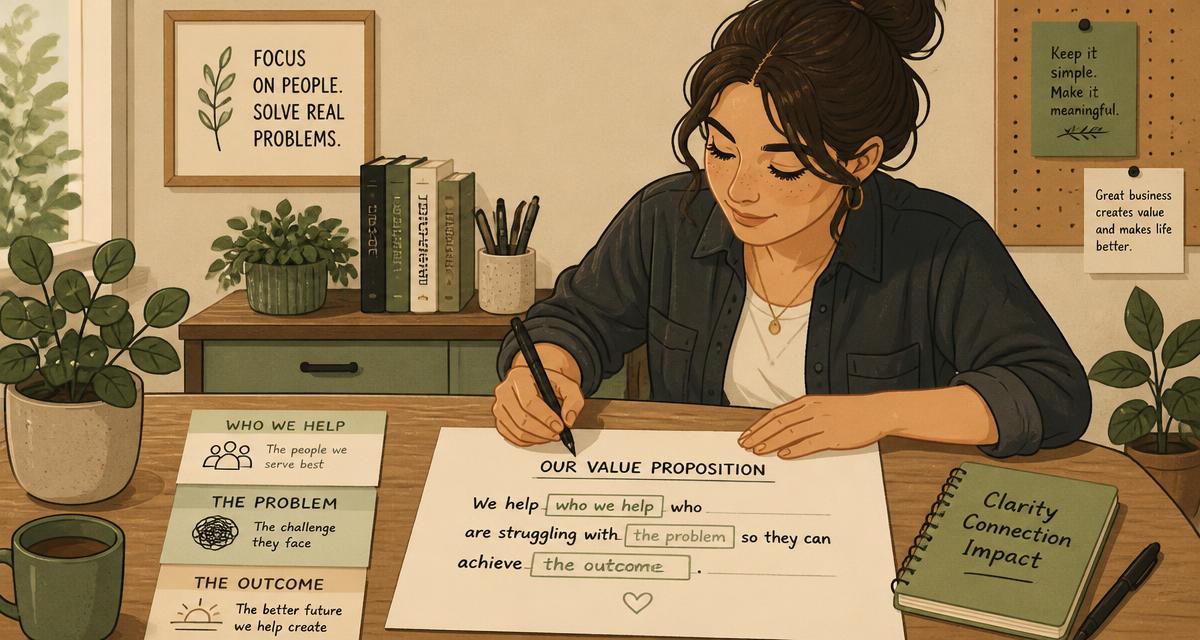
"We help [specific customer] achieve or solve [important outcome or problem] through [relevant approach or difference]."
- "We help owner-operated service businesses identify what is holding their marketing back and build a practical plan around their goals, audience and budget."
- "We help busy homeowners maintain cleaner, more comfortable homes through reliable scheduling and clear communication."
- "We help local property owners keep outdoor spaces maintained through consistent service and straightforward seasonal planning."
Adapt the structure rather than copying it word for word. A useful value proposition should be specific, relevant, easy to understand, credible, focused on the customer and supported by real business experience.
Avoid Weak or Generic Differentiators
These statements are usually too vague on their own:
- We care about our customers
- We provide quality service
- We are passionate
- We go above and beyond
- We offer competitive prices
- We are professional
- We are a one-stop shop
- We are the best
- Customer satisfaction is our priority
They may support a message, but they usually require proof or greater specificity.
Instead of "We provide excellent customer service," use: "Customers receive a written project outline, clear scheduling updates and one direct contact throughout the work."
Instead of "We offer competitive prices," use: "We explain what is included before work begins and provide options based on the customer's priorities and budget."
Show the Difference With Evidence
Support your positioning through customer reviews, process details, project examples, before-and-after examples where appropriate, credentials, founder experience, clear policies, service guarantees only when genuine and clearly defined, community involvement, educational content, transparent communication and a consistent customer experience.
A business should not only tell customers that it is different. The website, content and customer experience should make that difference visible. Educational content is one of the most reliable ways to do that — start by learning what customers actually want from your content.
Communicate the Value Proposition Across the Customer Journey
Your value proposition should appear consistently in your:
- Homepage headline
- About page
- Service pages
- Google Business Profile
- Social media profiles
- Sales conversations and proposals
- Email introductions
- Advertising and event materials
- Follow-up communication
The wording does not have to be identical everywhere, but the core idea should stay consistent so you communicate the same value across each marketing pillar.
Match the Message to the Audience
The same business may emphasize different benefits for different customer groups. A cleaning company may speak to:
- Busy parents: more time and less household stress
- Older homeowners: dependable support and clear communication
- Property managers: reliable scheduling and consistent service standards
The service may be similar, but the customer priorities are different. You should not create a completely different identity for every audience — the core value stays consistent while the emphasis changes.
Test Whether the Message Is Clear
Ask someone unfamiliar with the business to review your homepage or service description, then ask them:
- What does this business provide?
- Who is it for?
- What problem does it solve?
- What makes it different?
- What should the customer do next?
If the answers are unclear, simplify the message. Other options include comparing two homepage headlines, asking recent customers which message feels most accurate, reviewing which service descriptions generate better inquiries, listening for confusion during sales conversations and tracking whether lead quality improves.
Common Positioning Mistakes
- Trying to appeal to everyone
- Using vague claims
- Focusing only on features
- Copying competitor language
- Making claims without evidence
- Using too much industry jargon
- Changing the message constantly
- Choosing a difference customers do not value
- Confusing a low price with a complete strategy
- Describing the business without explaining the customer outcome
- Failing to support the message through the actual experience
A Simple Value-Proposition Exercise
Complete these statements:
- Our best-fit customers are:
- They usually come to us because:
- Their biggest concern is:
- The outcome they want is:
- Customers often choose us because:
- Our process or experience is different because:
- We can prove this through:
- The next step we want customers to take is:
Then use the answers to draft one or two clear sentences. Do not try to make the first version perfect. Test it in conversations, website copy and outreach, then improve it based on customer response. If you would rather work through it with someone, here is how to choose a marketing consultant for your small business.
Final Thoughts
Standing out does not require being completely unlike every competitor. It requires giving the right customer a clear and credible reason to consider your business.
Start with the customer's problem. Identify the parts of your process, experience and customer service that matter most. Listen to why customers choose you. Explain the value in plain language. Support the message with evidence.
Clear positioning makes every other marketing activity easier because customers can understand who the business helps, what it provides and why it may be the right choice.
Where to Start
Not sure whether your business clearly communicates what makes it different? Use the free Marketing Clarity Assessment to review your audience, value proposition, messaging and customer journey.
Take the Free Marketing Clarity Assessment
- Read Before You Spend More on Marketing
- Explore Services
- Browse free small-business marketing resources
- Contact Leonardo
Frequently Asked Questions
What is a small-business value proposition?
A value proposition explains who the business helps, what problem it solves, what outcome it supports and why the customer should consider it.
How can a small business stand out from competitors?
A business can stand out through a clearer customer focus, a better process, relevant expertise, stronger communication, a distinct customer experience or values demonstrated through action.
Is offering the lowest price a good differentiator?
It can influence some customers, but competing mainly on price can be difficult to sustain. Businesses should also explain value, quality, process and customer experience.
How do I know what customers value about my business?
Ask recent customers why they chose the business, review testimonials and sales conversations, and look for repeated themes in feedback.
Where should a business use its value proposition?
Use the core value proposition across the homepage, service pages, profiles, outreach, proposals, advertising and customer conversations.
Written by Leonardo “Leo” Sanchez
Leonardo “Leo” Sanchez is a New Jersey-based marketing strategy and customer experience professional and the founder of Simplify Branding & Marketing. He has more than 10 years of experience across marketing strategy, digital content, omnichannel engagement, commercial operations and business problem-solving. He is currently completing his MBA at Penn State. LinkedIn · Full profile
Get one practical small-business marketing tip each week.
No fluff. Just simple ideas to help improve your website, marketing, and lead generation.